First-resume guide
No experience? Your first resume still needs proof.
A first resume is not a list of jobs you have not held. It is a one-page proof page for what you learned, made, supported, or improved.
Start here
Use what is true. Make it easy to see.
A first resume is not a list of jobs you have not held. It is a one-page proof page for what you learned, made, supported, or improved.
Only include skills and outcomes you can explain in a conversation.
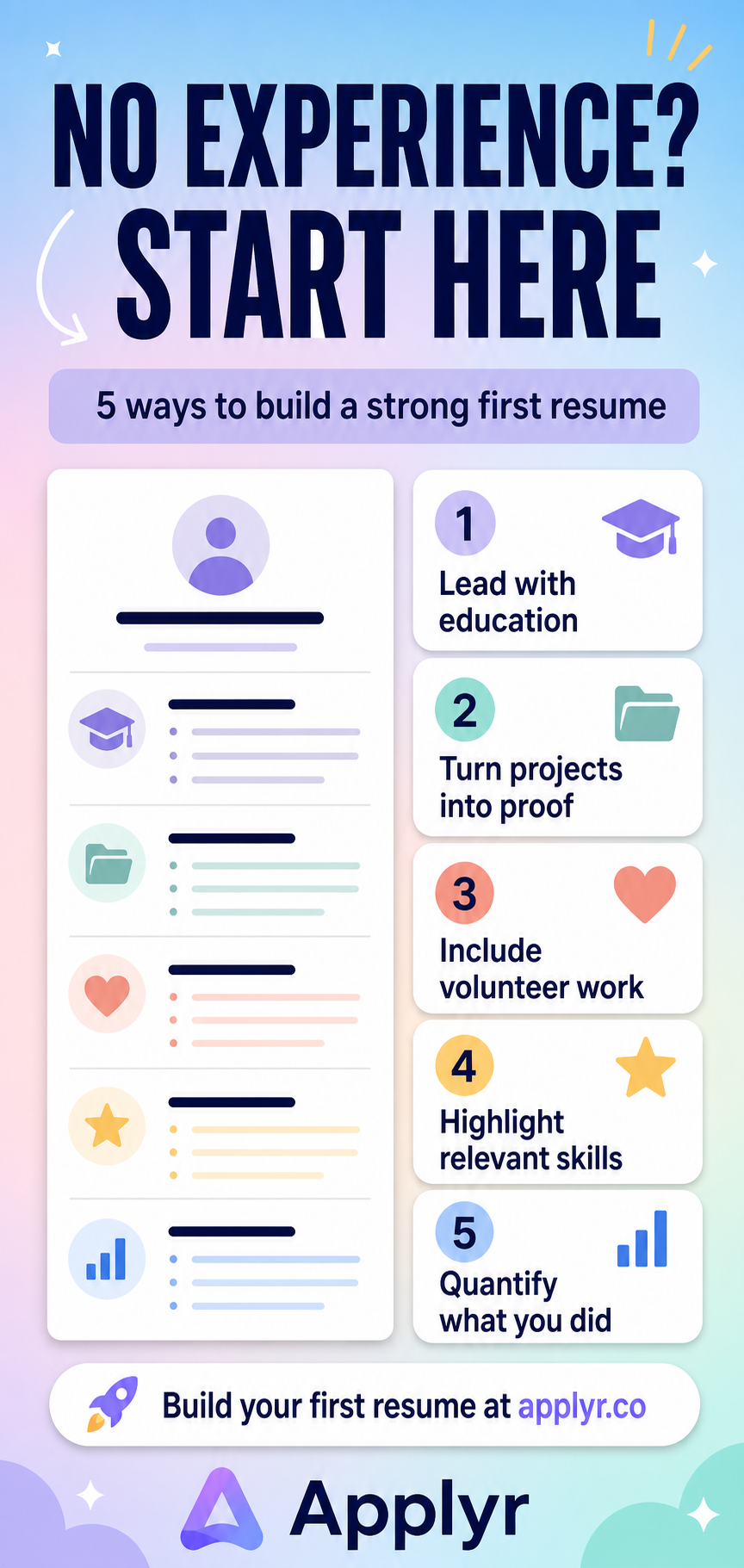
A five-step guide
Small, focused changes are easier to test.
Lead with education
Name your programme, graduation date, relevant coursework, honours, or a capstone only when it supports the role.
Turn projects into proof
Describe what you built, researched, organized, or delivered—not just the class name.
Include volunteer work
Use responsibilities that show reliability, coordination, customer contact, or community impact.
Highlight relevant skills
Choose tools and strengths that appear in the target role and are supported elsewhere on the page.
Quantify what you did
Use the number of people served, events supported, pages produced, or time saved when you can verify it.
Clarity check
Replace a claim with something you can point to.
A vague skill
“Strong leadership and communication skills.”
A supportable example
“Coordinated a four-person capstone team, scheduled weekly reviews, and presented the final proposal to faculty.”
Review before you send
Before you export, ask one question.
| What you notice | What to do next |
|---|---|
| The resume feels empty | Add a project, volunteer role, campus activity, or coursework only if it demonstrates a relevant skill. |
| The skills list is long | Keep only the skills you can connect to a project, course, or activity. |
| The target role is unclear | Name the role family in your headline and order your proof around it. |