A resume field guide for nursing students and new graduates
Clinical judgment belongs on your nursing resume. Show the decision, not just the duty.
“Provided patient care” names a duty. A stronger example lets the reader follow what you noticed, how you responded, and what you checked next—while keeping your supervision and scope accurate.
- Read time
- 7 minutes
- Best for
- Students + new grads
- Principle
- Proof over claims
What hiring readers need
Clinical judgment is not a personality trait.
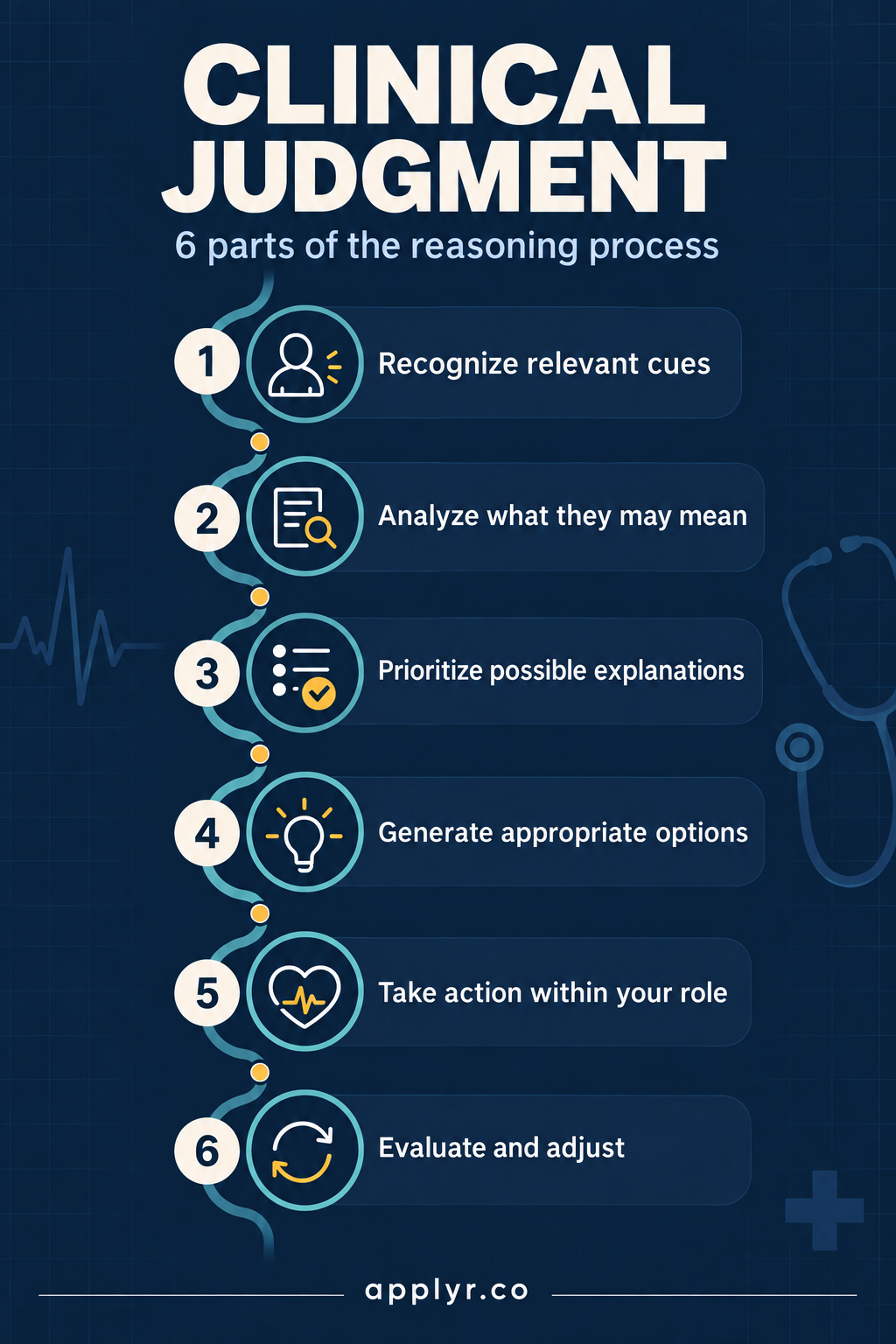
It is a decision process: noticing relevant information, interpreting it, choosing a safe response, acting within your role, and evaluating what followed. Your resume cannot prove every part of your practice—but one precise example can show how you approached a real situation.
The reasoning trace
Six parts of an example you can explain.
Use these as reflection prompts. Your final resume bullet may use only two or three of them.
- 01
Recognize the relevant cues
Name the information you noticed—not every detail in the situation.
- 02
Analyze what they may mean
Explain the connection you made within the knowledge and supervision you had.
- 03
Prioritize the concern
Show what needed attention first and why it mattered in that context.
- 04
Generate appropriate options
Describe the safe choices you considered, including when you sought guidance.
- 05
Take action within your role
State what you personally documented, communicated, checked, or completed.
- 06
Evaluate what happened next
Close the loop with the follow-up, response, handoff, or lesson you observed.
Framework informed by the NCSBN Clinical Judgment Measurement Model; adapted here only as a resume-reflection aid.
Your evidence map
Five places to look before deciding you have “no experience.”
- 01
Clinical rotations
A supervised moment when you noticed, communicated, documented, or followed up on a change.
- 02
Simulation
A scenario where your priorities changed as new information appeared.
- 03
Preceptorship or capstone
A longer experience that shows how you learned the unit workflow and escalation path.
- 04
CNA, PCT, EMT, or related work
Relevant observations and actions from the role you actually held—without converting them into RN duties.
- 05
Coursework and case studies
A concrete reasoning example when clearly labelled as academic rather than patient-care experience.
The evidence builder
Context → cue → action → follow-up
Write the full story privately first. Then compress only the most useful, supportable details into your resume.
Where were you?
Name the setting, your role, and the fact that it was supervised when applicable.
What did you notice?
Use the observation or information that changed what needed attention.
What did you do?
Keep the verb inside your real scope: documented, reported, clarified, reassessed, or assisted.
What happened next?
Show the handoff, response, recheck, escalation, or learning that closed the loop.
From vague to verifiable
Missing resume evidence is not missing ability.
“Demonstrated strong clinical judgment during rotations.”
The reader cannot see the setting, cue, action, or level of responsibility.
“During a supervised medical-surgical rotation, documented a change in patient observations and reported it through the established student and unit process.”
Adapt this only when every detail reflects your own experience.
Final safety check
Before the example reaches your resume.
- The setting and your actual role are clear.
- Supervision is named where it materially changes the reader’s understanding.
- Every clinical verb describes something you personally did.
- You did not add a diagnosis, outcome, or level of independence you cannot support.
- You could explain the example calmly in an interview.