Resume-bullets guide
Your resume bullets should show what changed because of your work.
Turn a list of duties into clear, credible evidence with a practical action + task + result framework.

Your work probably contains more evidence than your resume shows. The problem is rarely a total absence of value. More often, the useful details are trapped in task language: what you were assigned, which tools you used, and what appeared on a weekly checklist. This guide helps you recover the part a reader needs in order to understand your contribution—what you did, where you did it, and what became different because you were involved.
Never add a number you cannot defend. A precise qualitative effect is stronger than false precision, and a modest truthful claim is easier to discuss than an impressive line you cannot explain.
Diagnose the gap
Why duty lists feel weak
A duty tells a reader what belonged to the job. It does not yet show how you approached the work, how much responsibility you carried, or why the activity mattered. “Responsible for reports” could describe copying figures into a template, rebuilding a broken process, or giving leadership the first reliable view of a problem. Those are very different contributions, but the duty phrase makes them look identical.
This does not mean every bullet needs a dramatic business win. Routine work can be valuable when the context is visible. Accuracy, consistency, coverage, response time, safer handoffs, clearer information, and dependable service are legitimate effects. The aim is not to inflate ordinary work. It is to stop erasing the judgment and care that made the work useful.
Begin by asking what the task protected, enabled, accelerated, clarified, or delivered. If you cannot answer yet, look at the people who used the work, the decision it supported, the problem it prevented, or the condition that improved. That inquiry is more productive than searching for a stronger verb in isolation. A polished verb cannot rescue a bullet that still leaves the reader guessing about the contribution.
Build the sentence
Use action + task + result as a diagnostic
The formula is simple: name the action you personally took, add enough task or context to make the work understandable, then state a result or effect you can support. Think of it as a set of questions, not a rigid sentence template. Some bullets will read naturally in that order. Others may lead with scale, a problem, or an outcome. The value of the formula is that it reveals what is missing before you polish the line.
Action means your contribution, not the department’s collective ambition. Choose a verb you could defend in conversation: analyzed, coordinated, built, reconciled, resolved, trained, scheduled, documented, tested, or delivered. Task or context answers “on what, for whom, or under what conditions?” Result answers “what changed, became possible, or was protected?” The result can be quantitative or qualitative, but it must stay connected to the action.
Two parts can be enough when the effect is already clear. “Resolved billing questions for enterprise customers during a system migration” communicates action and demanding context even without a separate metric. Do not force a result clause that repeats the task or implies evidence you do not have. Use the formula to strengthen meaning, then edit for a sentence that sounds like you.
Recover evidence
Results you can use without revenue numbers
Revenue is only one kind of evidence, and many roles are several steps away from it. A coordinator may protect a deadline. A support specialist may restore clarity for a frustrated customer. An administrator may make records dependable. A junior employee may create coverage, complete a careful analysis, or help a team deliver during a busy period. Those effects matter even when nobody attached a dollar amount to them.
Look for evidence in seven places: time, volume, scale, quality, risk, support, and changed process. You might know an exact figure, a defensible range, or only the observable effect. Use the most specific version you can explain without exposing private information. “Reduced the time needed for weekly reconciliation” can be credible without claiming an exact percentage. “Supported onboarding across three departments” uses scale without revealing confidential performance data.
If a result is sensitive, move one level up. Name the kind of effect rather than the private figure: improved forecast consistency, reduced duplicate work, protected a deadline, clarified ownership, or gave managers a reliable view. If you only know that your manager or customer used the output, say what decision or next step it supported. The goal is defensible context, not maximal disclosure.
Time
What became faster, more predictable, or easier to complete?
Shortened a recurring handoff by removing duplicate review steps.Volume
How much work did you process, coordinate, review, or deliver?
Reviewed a steady weekly queue while maintaining documented checks.Scale
How many teams, locations, products, customers, or records were involved?
Coordinated one reporting process across three operating teams.Quality
What became clearer, more accurate, consistent, or usable?
Standardized intake notes so the next team received complete context.Risk
What error, delay, compliance issue, or service failure did the work reduce?
Added a pre-release check that caught incomplete account details.Support
Who could decide, deliver, learn, or respond because of your contribution?
Prepared concise summaries that helped managers prioritize follow-up.Changed process
What now happens differently because you improved the workflow?
Replaced separate trackers with one shared weekly status view.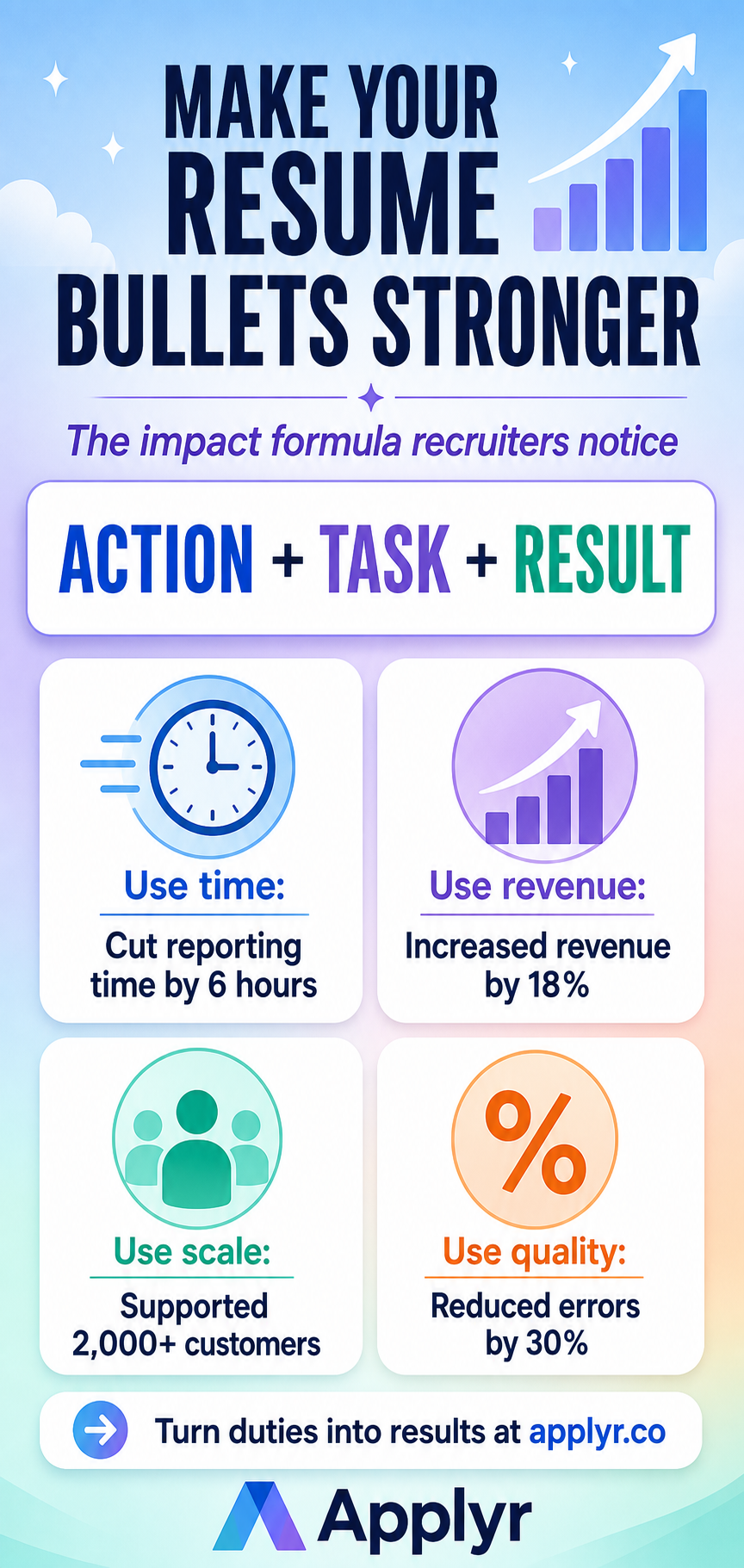
See the difference
Before-and-after examples across different roles
The pairs below are illustrative. They show how the same underlying duty can become more informative when ownership, context, and effect are visible. They are not templates to copy word for word, and their details are not facts about your work. Borrow the questions each example answers, then replace every detail with evidence from your own experience.
Notice that the stronger versions are not simply longer. Each one makes a choice about what matters. The operations example emphasizes continuity. The support example emphasizes resolution and handoff quality. The early-career example uses preparation and decision support rather than pretending the student owned the final decision. Strong bullets are selective: they give one contribution enough space to be understood.
Operations
Before
Responsible for weekly schedules.
After
Coordinated weekly schedules for field teams, resolving coverage gaps before assignments were released.
Why it works: The revision shows ownership, operating context, and the effect on continuity without requiring a private metric.
Customer support
Before
Answered customer questions.
After
Resolved account and billing questions, documenting complex cases so specialist handoffs kept the customer’s full context.
Why it works: The line distinguishes routine response work from resolution and reliable escalation.
Administration
Before
Maintained files and records.
After
Reconciled contract records across shared folders, giving the team one current source for renewal preparation.
Why it works: The result is a dependable process, not an unsupported claim about revenue.
Marketing
Before
Created campaign reports.
After
Built a recurring campaign summary that connected channel activity with qualified-response trends for weekly planning.
Why it works: The revision names the decision the report supported while avoiding a causal sales claim.
Technical work
Before
Fixed software bugs.
After
Investigated and resolved recurring validation defects in the account workflow, reducing repeat support escalations tied to the same issue.
Why it works: The bullet connects diagnosis and repair to an observable operational effect.
Early-career project
Before
Helped with a research project.
After
Cleaned and categorized survey responses for a supervised research project, preparing a consistent dataset for the team’s analysis.
Why it works: The wording respects supervised scope while making the student’s concrete contribution visible.
Try the method
Build one bullet in the worksheet
Choose one duty from your current resume. Start with a contribution you remember clearly, not the line you think will sound most impressive. In the Action field, write what you personally did. In Task or context, identify the work, audience, challenge, or scale. In Result or effect, add the change you can support. The third field is optional because honest context is better than a manufactured outcome.
Treat the assembled line as a first draft. Read it aloud. Remove repeated words, vague intensifiers, and context your target reader does not need. If the result feels disconnected, ask what step in your action produced it. If you cannot make that connection, soften the claim or omit it. The worksheet does not score or rewrite your words; it simply keeps the three evidence questions visible while you draft.
Bullet workbench
Turn one duty into a draft
Use your own facts. Action and context are required; add a result only when you can explain the connection.
Live draft
Pressure-test the claim
Test whether the bullet is defensible
A good bullet should survive a calm follow-up question. Could you explain what you owned, what other people contributed, how the result was observed, and why you chose the wording? If a line only works while nobody asks for detail, it is not ready. Defensibility is not about having perfect records. It is about keeping the wording inside what you genuinely know.
Check confidentiality at the same time. Replace client names, private financial figures, security details, or sensitive internal targets with a non-sensitive category, rounded scale, or qualitative effect. Then check relevance. A true bullet can still be the wrong bullet for a particular application. Prioritize the evidence that helps the target employer understand how you could contribute in the work they described.
Finally, check ownership language. “Led” should mean you directed the work; “supported” should not hide substantial responsibility you actually held. Give collaborators appropriate context without dissolving your contribution into “we.” The strongest wording is the one that remains accurate when you describe the project out loud.
- I can explain what I personally owned and what collaborators contributed.
- Every number, range, and scale marker comes from information I can support.
- The result follows plausibly from the action without overstating causation.
- Private client, financial, security, and internal performance details remain protected.
- The wording matches the level of responsibility I actually held.
- I could discuss this example clearly in an interview without changing the story.
Review the page
Final review checklist
Review the resume as a set, not just one sentence at a time. Repeated formulas can make different accomplishments blur together. Vary the evidence: one line may show a changed process, another the scale of service, another a risk handled or decision supported. Keep the most relevant proof high in each role and remove lines that merely restate the job title.
You do not need to transform every duty into a quantified achievement. You need enough clear, credible evidence for a reader to understand the pattern of your contribution. Use the checklist below to revise the next few bullets, then compare the page with the role you are targeting. The resume should make the relevant part of your work easier to see, not turn your career into advertising copy.
Each bullet contains one main contribution rather than several unrelated duties.
The opening verb describes my action instead of a vague responsibility.
The context makes the task, audience, challenge, or scale understandable.
Results are specific where evidence exists and qualitative where that is more truthful.
Repeated bullets show different contributions rather than the same formula.
The strongest relevant evidence appears early in each role.
Confidential details are generalized without erasing the operational effect.
Every line is written in language I can explain naturally and defend.